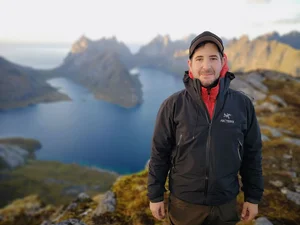
Choosing a Camera for Landscape Photography
"Hey Felix, I want to learn photography — which camera should I buy?"
This is, by far, the most asked question I get over on my Instagram account @felixinden.
After more than 15 years of landscape photography I know a thing or two about cameras. But this question is still almost impossible to answer well, because so many factors go into it. So read this article to the end — by the time you finish, you might realise you're better off focusing on something else entirely first. And that something won't cost you anything but time.
A lot has changed since I first wrote this guide. The DSLR era is over: Nikon, Canon and Sony have all stopped developing them, and every serious new camera today is mirrorless. Sensors, autofocus and in-body stabilisation have taken big leaps. Fujifilm — which I left out of the original version — has become one of the most interesting brands for landscape shooters, in both APS-C and genuinely affordable medium format. And medium format itself, once a studio-only fantasy, is now something you can hike with. So I've rebuilt the whole list from scratch.
What actually matters in a landscape camera
Before the models, here's what to weigh up. If you only remember one thing: for landscapes you are almost never chasing autofocus speed or frame rates. You're after quality of shake reduction, low light performance, etc.
Dynamic range — how much detail the sensor holds in deep shadows and bright skies at once. This matters more than almost anything for sunrise and sunset work.
Resolution (megapixels) — useful for big prints and for cropping. But more isn't automatically better: bigger files need a stronger computer and fast storage, and beyond a point the gains are invisible unless you print large.
Weather sealing — you'll be out in wind, rain, spray and cold. A sealed body earns its keep.
In-body stabilisation (IBIS) — lets you shoot handheld in low light, and enables high-resolution pixel-shift modes on a tripod.
A tilting screen — sounds minor, saves your back and knees a hundred times a trip.
Battery life and the lens system — the body is temporary; the lens mount you buy into is a long-term commitment. Pick a system with the wide-angle and landscape glass you'll actually want.
Keep these in mind as you read — they explain why I recommend what I recommend.
Before you pick a body — the free framework I run through on every shoot, whatever camera's in my hands.
Cerro Torre, Los Glaciares National Parc, Patagonia Argentina - Nikon Z8 + Nikkor Z 14-24 f/2.8 S at 14mm, ISO64, f11, 0.6”
Camera bodies for beginners
Great entry-level cameras to find out whether photography is for you, without spending a fortune. All mirrorless, all with modern lens systems behind them. Pair any of them with the kit zoom plus, if you can, a cheap fast prime (a 50mm-equivalent f/1.8 or f/2) to really start playing.
| Camera | Sensor | MP | Approx. price (body/kit) | Notes |
|---|---|---|---|---|
| Nikon Z50 II | APS-C | 21 | ~$910 / ~$1,050 kit | Flagship-level autofocus (EXPEED 7) in an entry body; superb value |
| Canon EOS R50 | APS-C | 24 | ~$680 kit | Tiny, articulating screen, animal detection. (R100 is cheaper at ~$480 but more basic) |
| Sony a6400 | APS-C | 24 | ~$900 | Still sold, still capable; opens up Sony's huge E-mount lens range |
| Fujifilm X-T30 II | APS-C | 26 | ~$900 | Dial-based controls and Fuji's film simulations — a lovely way to learn |
My pick of this group is the Nikon Z50 II — it inherits the autofocus brain from Nikon's pro bodies, which is wild at the price. But honestly, if you already feel the landscape passion growing while reading this, skip ahead. You may catch a case of GAS (gear acquisition syndrome) sooner than you think, and "buy cheap, buy twice" is very real with this gear.

Cosy in my cabin at Eliassen Rorbuer, Hamnoy (Lofoten) Norway - Nikon D800 + Nikkor 14-24 2.8, ISO400, f11, 25”
Camera bodies for intermediate / enthusiast photographers
If you already know you want to go deep, save a little longer and start here. This is the sweet spot in 2026 — full-frame is more affordable than it's ever been, and the high-end APS-C bodies are seriously good.
| Camera | Format | MP | Approx. price | Why it's here |
|---|---|---|---|---|
| Nikon Z5 II ⭐ | Full-frame | 24.5 | ~$1,700 | The standout value in full-frame. Modern EXPEED 7 processor, great dynamic range, weather-sealed |
| Nikon Zf | Full-frame | 24.5 | ~$2,000 | Same sensor/brain as the Z5 II in a retro body, with a 96MP pixel-shift mode for tripod work |
| Canon EOS R8 | Full-frame | 24 | ~$1,500 | Canon's lightest, cheapest full-frame — a lot of sensor for the money |
| Canon EOS R7 | APS-C | 32.5 | ~$1,400 | Canon's best APS-C; high resolution and the same AF system as the pro bodies |
| Sony a6700 | APS-C | 26 | ~$1,400 | Excellent modern crop sensor, superb autofocus, small and light |
| Sony a7 IV ⭐ | Full-frame | 33 | ~$2,200 | One of the best all-rounders for the money — a widely-loved landscape value pick |
| Fujifilm X-T5 ⭐ | APS-C | 40 | ~$2,000 | A 40MP stills-first body with IBIS and weather sealing — a brilliant landscape camera |
| Fujifilm X-T50 | APS-C | 40 | ~$1,400 | The same 40MP sensor in a smaller, cheaper body |
Two I'd single out. The Nikon Z5 II is, to me, the obvious "first serious camera" — full-frame quality, the current-generation processor, and you grow into the Z lens range. And the Fujifilm X-T5 proves you don't need full-frame for landscapes: 40 megapixels of APS-C, beautiful colours out of camera, and a joy to shoot with those physical dials. If you'd rather a do-it-all full-frame, the Sony a7 IV is the classic all-rounder here, and Canon's R8 is the cheapest route onto full-frame without giving up the sensor.
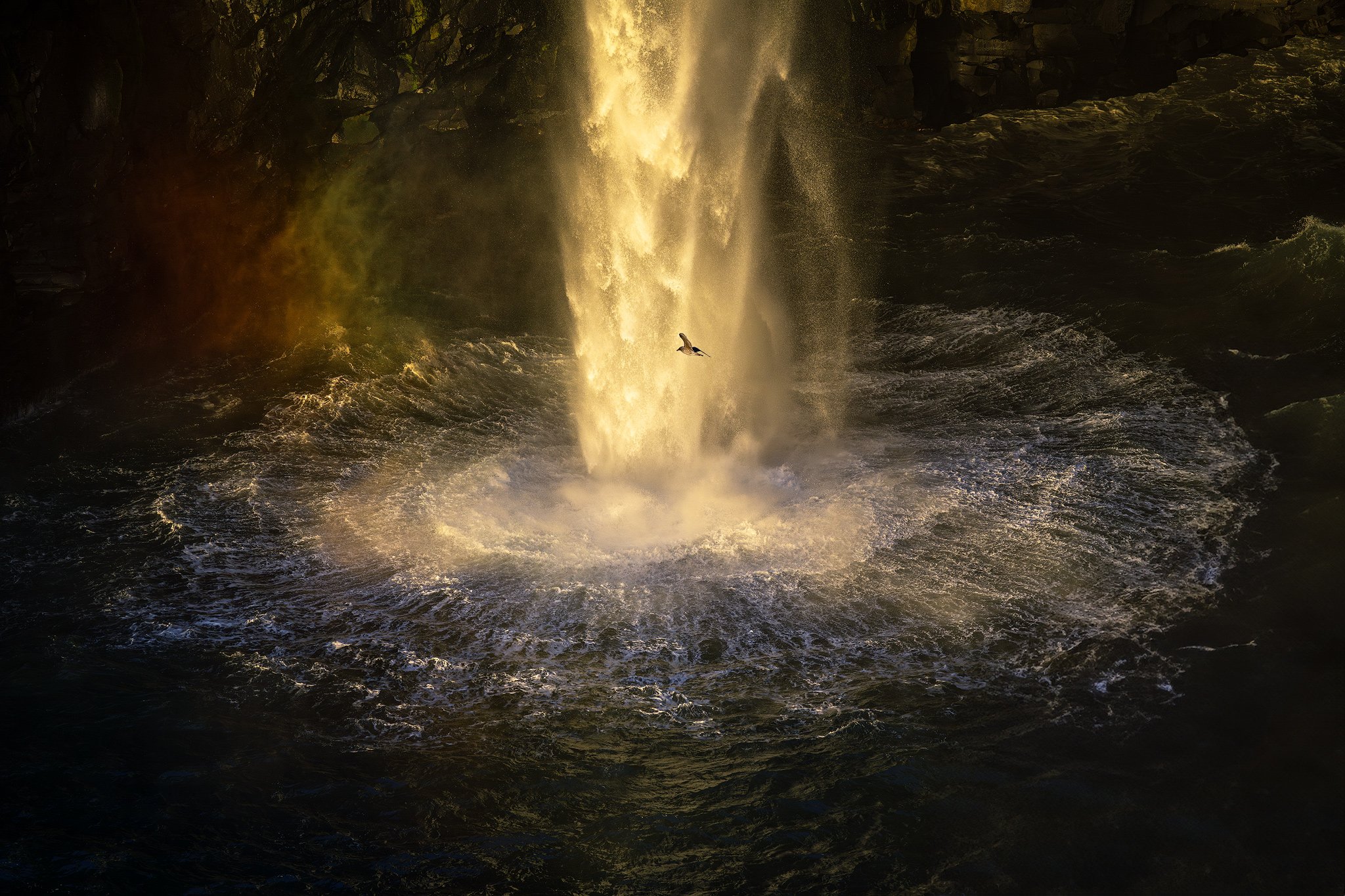
Fulmars Playtime at Gasadalur, Faroe Islands - Nikon Z8 + Nikkor Z 100-400 4.5- 5.6 S, ISO800, f8, 1/1000”
Camera bodies for advanced photographers
The top tier of full-frame. These are real investments — be sure landscape photography is your passion before you spend here. Every one produces professional-grade files. A heads-up that still applies in 2026: high-resolution files are big. You'll likely want a capable computer and fast, roomy storage, or your editing — luminosity masks, focus stacks, big panoramas — will crawl.
| Camera | Format | MP | Approx. price | Why it's here |
|---|---|---|---|---|
| Nikon Z6 III | Full-frame | 24.5 | ~$2,500 | Partially-stacked sensor, superb all-rounder; the bridge into this tier |
| Nikon Z7 II | Full-frame | 45.7 | ~$2,600 new / ~$1,500 used | Still a high-resolution bargain, especially used |
| Nikon Z8 | Full-frame | 45.7 | ~$3,800 | The D850's true heir and my personal workhorse — the body I find most practical to live with, even though it's not the outright best (more below) |
| Nikon Z9 | Full-frame | 45.7 | ~$5,200 | The flagship — overkill for pure landscape, unbeatable if you also shoot wildlife |
| Canon EOS R6 Mark III | Full-frame | 32.5 | ~$2,800 | The newest Canon all-rounder if you want a lighter, cheaper pro body |
| Canon EOS R5 Mark II | Full-frame | 45 | ~$4,400 | Canon's landscape flagship: high resolution, huge dynamic range, 8K |
| Panasonic Lumix S1R II | Full-frame | 44 | ~$3,300 | 44MP, brilliant IBIS and 8K; opens the L-mount system shared with Leica and Sigma |
| Sony a7CR | Full-frame | 61 | ~$3,000 | 61MP in a compact body — fantastic for travel and hiking |
| Sony a7R V | Full-frame | 61 | ~$3,900 | The 61MP landscape benchmark — now the value high-res pick beneath the VI |
| Sony a7R VI 🏆 | Full-frame | ~67 | ~$4,500 | My overall winner, and the consensus pick — highest resolution, on Sony's vast, fastest-evolving lens system |
| Sony a1 II | Full-frame | 50 | ~$6,500 | The do-everything flagship — built for speed, but a stunning landscape file too |
A few honest words on this tier, because there isn't a weak camera in that table. On pure capability the Sony a7R VI leads — the full reckoning is a little further down. But Canon's R5 Mark II is a genuine landscape flagship, with the colour science Canon shooters swear by and a fast-maturing RF lens range behind it; the R6 Mark III is the lighter, friendlier door into the same system. Panasonic's S1R II brings 44 megapixels and class-leading stabilisation on the open L-mount it shares with Leica and Sigma, which makes it a quietly clever long-term bet. And the one I keep coming back to personally is the Nikon Z8 — not because it wins on paper, but because it's the camera the D850 always wanted to be, and it's why I no longer say "the DSLR era isn't over." It is.
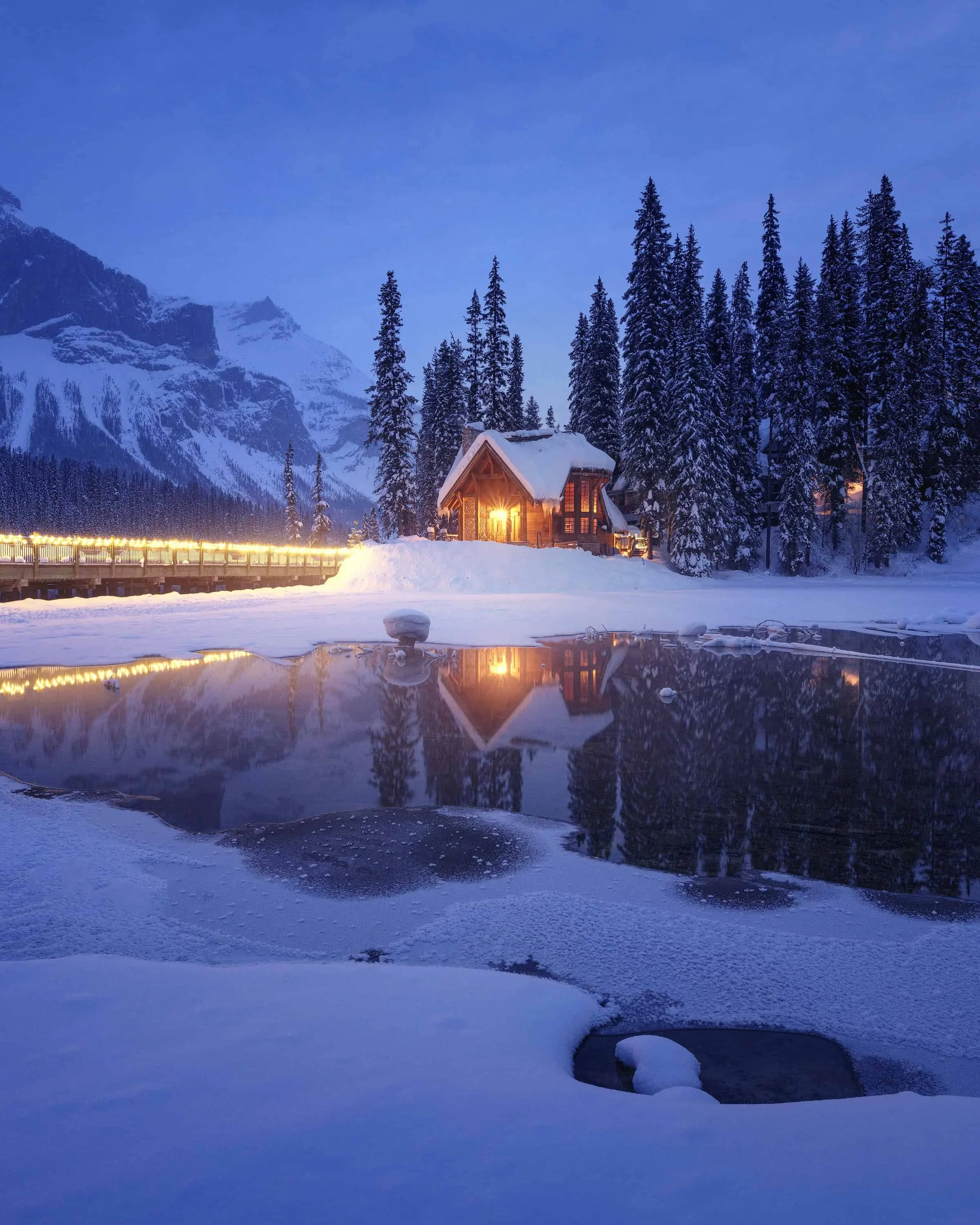
Twilight at Emerald Lake Lodge in the Canadian Rockies - Nikon Z8 + Nikkor Z 12-14 f/2.8 S, ISO400, f8, 30”
The dream tier: medium format & boutique cameras
This is where gear lovers really start drooling. You don't need any of these for stunning landscapes — but if outright image quality, or sheer joy of ownership, is the goal, this is the frontier. Medium-format sensors are roughly 1.7× the area of full-frame, which means enormous resolution and dynamic range. And there's never been more choice.
| Camera | Format | MP | Approx. price | Why it's special |
|---|---|---|---|---|
| Fujifilm GFX 50S II | Medium format | 51 | ~$4,000 | The most affordable way into medium format, full stop |
| Fujifilm GFX100RF | Medium format (fixed lens) | 102 | ~$4,900 | A 102MP medium-format compact with a fixed 28mm-equivalent lens — pocketable big-sensor magic |
| Fujifilm GFX 100S II ⭐ | Medium format | 102 | ~$5,000–5,700 | 102MP in a body that fits a backpack — the IQ sweet spot of the whole list |
| Fujifilm GFX 100 II | Medium format | 102 | ~$8,000 | The full-fat flagship GFX: faster, better viewfinder, the works |
| Hasselblad X2D II 100C ⭐ | Medium format | 100 | ~$7,400 | Elite pure image quality — 100MP, 10-stop IBIS, legendary colour, 1TB built-in SSD. Specialised, with a telephoto blind spot (below) |
| Leica SL3 | Full-frame | 61 | ~$7,000 | 61MP, L-mount, built like a tank, with the red dot and the rendering people fall in love with |
| Leica Q3 | Full-frame (fixed lens) | 60 | ~$6,000 | A 60MP fixed 28mm full-frame compact — arguably the most desirable "one camera, one lens" tool made |
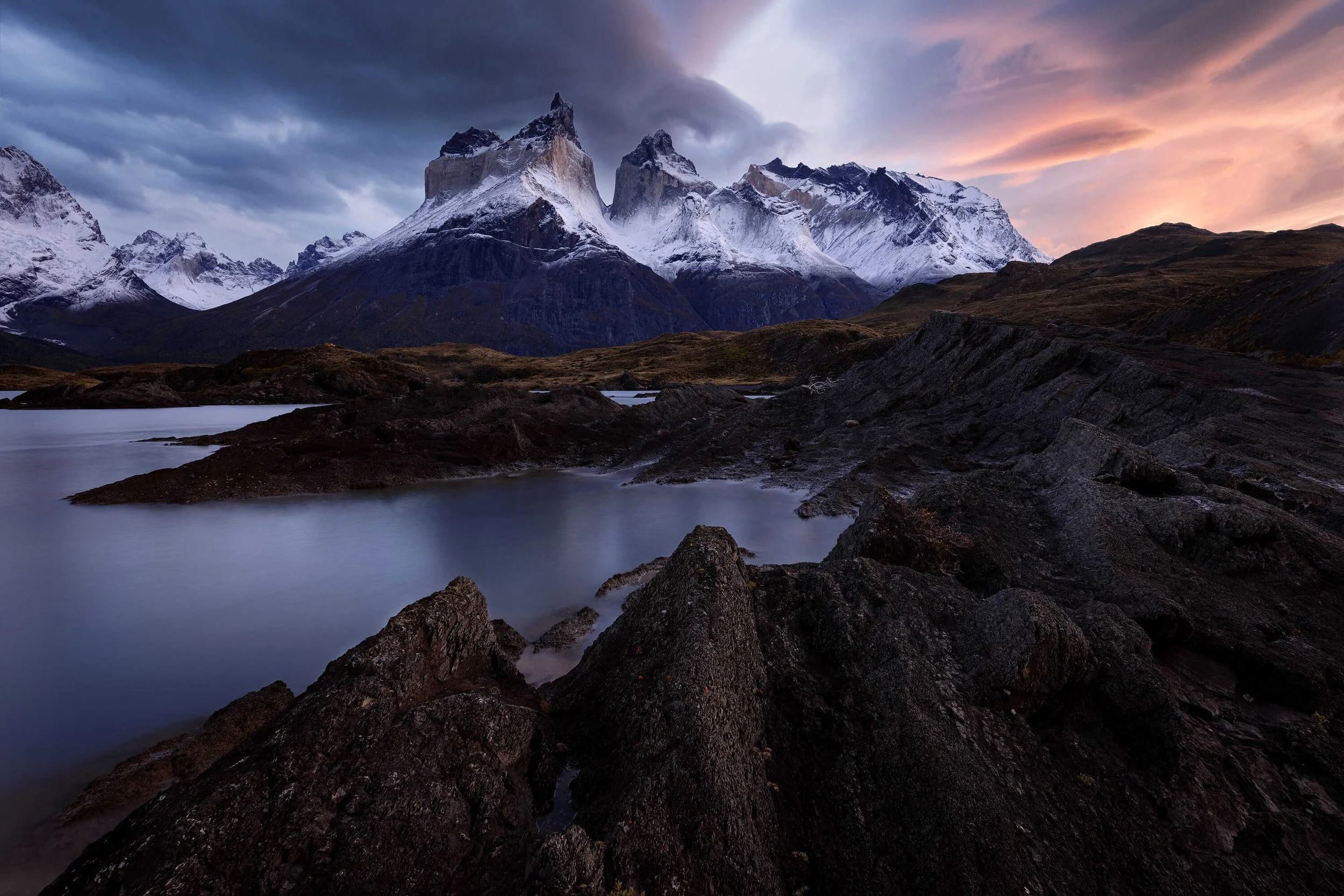
The majestic Cuernos, Torres del Paine NP in Patagonia, Chile - Nikon D850 + Nikkor 14-24 f/2.8, ISO64, f11, 25”
The two headline changes since the old version of this article: medium format is now reachable (a few years ago, 100 megapixels meant five figures and a studio — the Fujifilm GFX bodies and the Hasselblad X2D II 100C put it in a backpack), and the fixed-lens big-sensor compacts like the GFX100RF and the Leica Q3 have created a whole new category for travelling light without giving up image quality.
So which of all these is actually the best? It helps to split that into two different questions — which makes the best files, and which is the best camera to live with — because they don't have the same answer.
On outright image quality and capability, there's a clear winner, and it's the one most people expect: the Sony a7R VI. It's the newest and highest-resolution full-frame body on the market — but just as important, it sits on the most versatile system of all. Sony's E-mount has the widest lens selection of any brand, first-party plus Sigma, Tamron and the rest, and Sony keeps pushing the technology and releasing new glass faster than anyone. If you want a system that will keep moving forward and never leave you hunting for a lens, that's the one. If I could only recommend a single camera here, it would be this.
Just behind it on pure file quality is the Hasselblad X2D II 100C — those 100 medium-format megapixels and that Hasselblad colour are genuinely in a league of their own. But it's a far more specialised, less flexible tool, and it has one big catch worth knowing before you fall in love: the X System has no real long-telephoto solution. Its longest native reach is the XCD 135mm with the 1.7x converter — only about 178mm in full-frame terms. So it's glorious for wide and standard focal lengths, but those compression-heavy super-tele shots (distant peaks stacked together, a tiny subject against a vast backdrop) are simply off the menu.
The Fujifilm GFX system at least reaches further — Fuji makes a GF 500mm f/5.6 (around 400mm full-frame equivalent) that delivers gorgeous compression. But it's a big, roughly $4,000 fixed prime, and once it's on a medium-format body you're carrying a seriously expensive, specialised rig. The honest truth: if telephoto compression is what you're after, a normal full-frame body with a 100-400 zoom is lighter, cheaper, far more flexible and more practical than any medium-format tele setup. Medium format wins at the wide and standard end; for the long end, full-frame and a 100-400 still beat it on usability every time.
Which brings me to the camera I'd personally reach for. For me, "best sensor" and "best camera to actually get the shot" aren't the same thing — and by that second measure the Nikon Z8 is the most practical workhorse of the lot. It won't out-resolve the Sony or out-colour the Hasselblad, and I won't pretend otherwise. But it's fast, properly weather-sealed, the files behave exactly how I expect because I've edited thousands of them, and the lenses run from ultra-wide to long tele with no gaps. It gets out of my way when the light is doing something I'll only ever see once — and that's worth more to me than any spec-sheet crown.
But here's the thing none of these price tags will tell you: not one of these cameras is what actually makes a great landscape photograph.
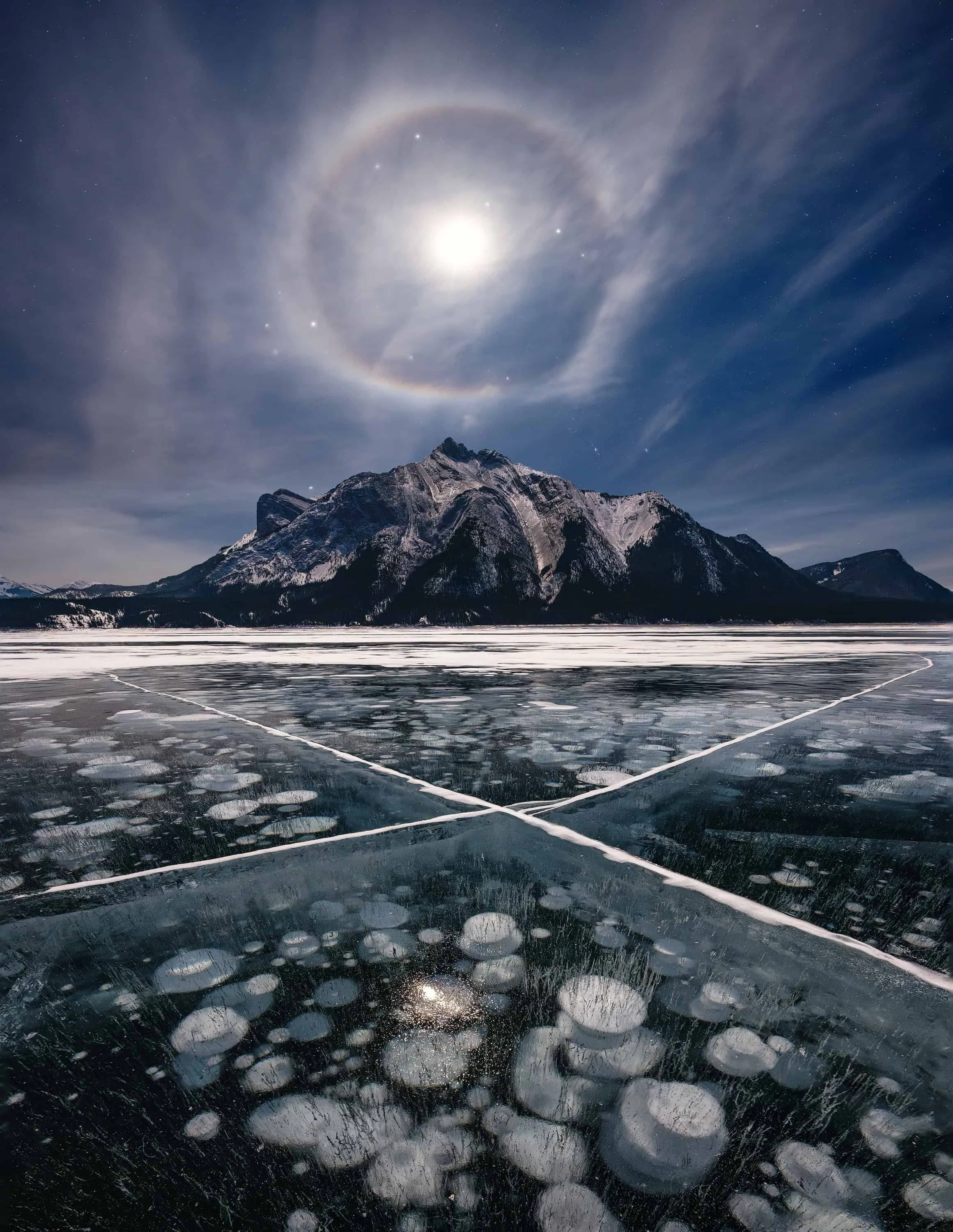
Frozen magic at Abraham Lake, Canadian Rockies - Nikon Z8 + Nikkor Z 14-24 f/2.8, ISO2000, f4, 12”
Now that the recommendations are out of the way, let me get a little philosophical
Let me start with some honesty about myself. If you've followed my work for a while, you know I like good equipment. I enjoy technology and I enjoy watching camera tech evolve. I don't preorder every new release, but when a camera brings something that genuinely saves me time in the field or in post — or lets me capture something that wasn't possible before — I have a hard time holding back.
I'll also be honest about my limits: I'm not a camera-tech expert and I don't work in a camera store. I'm not an engineer and I won't read a 400-page manual. The way I test a camera is to grab it, go somewhere beautiful, and shoot landscapes. So take my recommendations for what they are — a working photographer's view, not a lab review.
What I do have is mileage. Over the years I've led hundreds of photographers on expeditions and workshops, and they turn up with everything — every Nikon, Canon, Sony and Fujifilm body you can think of, the odd Panasonic, and now and then a Leica or a Hasselblad. I've stood shoulder to shoulder with all of them when the light suddenly caught fire and we had thirty seconds to nail the shot, so I've seen first-hand which systems are quick and intuitive when it matters, and which ones fight you. And back home, I've spent countless editing sessions working on their RAW files next to my own — pushing shadows, recovering skies, preparing big prints — so I know how each manufacturer's files actually behave once you start working them. That hands-on experience, across just about every system and many thousands of files, tells me more than any spec sheet ever could.
For the record, here's what's actually in my bag these days. I shoot Nikon — not because anyone pays me to (more on that below). Honestly, it's mostly because I'm already deep in the system: I have the bodies, I have the glass I love, and I see no reason to spend a fortune rebuying everything in another mount. That's a perfectly good reason to stay put, and it's the same one most working photographers have for not switching brands on a whim:
Bodies: Nikon Z8 and Nikon Z7 II
Lenses: Nikkor Z 12-24mm f/2.8 S, Nikkor Z 24-120mm f/4 S, Nikkor Z 100-400mm, plus two Laowa gems — the 10mm f/2.8 and the 100mm f/2.8 CA-Dreamer Macro
Support: Really Right Stuff TVC-33 tripod and BH-55 ballhead, and a Benro Polaris for tracked and time-based work
Filters: Maven
From the air: DJI Mavic 4 Pro
Carrying it all: NYA-EVO bags — here's my full review of the Fjord 60-C
And here's the thing that hasn't changed one bit since I first wrote this:
It has never mattered less which camera you use, when it comes to the potential quality of your images
Click to see bigger if you are using a mobile device
Smartphones long ago overtook point-and-shoots, and mirrorless has fully replaced the DSLR. But none of that changes the core truth: in 99% of cases, the same image is possible with older, cheaper or "inferior" gear. It might just take more work in the field and in post.
So before you buy, ask yourself why you need a new camera
In maybe 90% of cases, it isn't the gear holding you back from better photographs. The exceptions are real but narrow — you genuinely have no decent camera yet, or you're chasing a specialised field where technology really does help (astrophotography and night work, or shooting high-quality video alongside your stills, which more and more landscape photographers want to do).
You will gain so much more by focusing on the things that actually make a photograph:
Composition
Handling of light
Shutter speed
Harmony of colours
Postproduction
And the best part? None of these ever go out of date, and you can practise every one of them on a two-year-old phone.

Complete Escalation at Gasadalur, Faroe Islands - Nikon Z8 + Nikkor Z 14-24 f/2.8 S
One example from the field. Take a bag full of professional gear to an inspiring place — at midday. Then come back to the same spot with only a cheap beginner kit a few hours later, during the golden light of early morning or evening. The beginner-camera images, shot in that soft low light, will beat the pro-gear images shot under harsh midday sun. Every time. The importance of the camera is simply dwarfed by the importance of when you choose to shoot.
So what will change your image more? A long exposure that turns water silky and dreamy (after you reach for a neutral-density filter)? Cutting glare off a wet surface with a polariser? Or a sensor with 20 more megapixels?
That's why I always feel a bit uneasy leading with camera recommendations when someone asks me what to buy. I've seen it too many times — people pour attention into gear instead of skills. And the knowledge is everywhere now, much of it free: endless YouTube, and free articles like the ones here on my site.
Something I'm building for you
For a while now I've been quietly working on my own landscape photography course — everything I've learned over 15+ years about light, composition, being in the right place at the right time, and the postproduction that ties it together. That last part is something I've refined over hundreds of editing sessions on files from just about every camera system out there, and it's the resource I wish I'd had when I started.
It's not quite ready yet, but I'd love to have you in the room when it opens. The best way to get early access (and an early-bird price) is to join my newsletter below — that's where I'll announce it first.
On a personal note: I've been where you are. More than once I hit a dry, uninspired patch, bought a new camera, and suddenly felt motivated again. New gear can be a spark — just remember it isn't required to improve, for almost any of us. If your budget is tight, don't go into debt over a body. Learn while you save. When you can finally afford your dream camera, you'll already know how to make it sing.
You made it through all my rambling and you're still here — that's great. I hope this gave you something useful to chew on, and maybe nudged you to ask whether you really need new gear, or whether your money is better spent on knowledge or a trip somewhere beautiful.
Before you go — grab The Field Method, free
I've spent this whole article telling you the camera matters less than knowing what to do with it. So here's the thing that actually moves the needle: The Field Method — the four checks I run before pressing the shutter in any landscape, anywhere in the world. The Anchor, Edge Control, the Layers, and the Light Rule. Read it in two minutes, use it for the rest of your life.
Grab the free PDF and I'll also send you Postcards from the Wild — field stories from my expeditions, twice a month.
A note on independence: I used to be a Nikon-sponsored photographer; I'm not anymore. I still shoot Nikon, but as I said above, that's mostly because I'm already invested in the system and don't fancy rebuying everything — not because it's the only "right" choice. As you can see, this guide is far from Nikon-only. There are no paid placements or affiliate links in this article — every recommendation is just my honest opinion.
Conclusion
"Buy cheap, buy twice" holds especially true for landscape gear. If you can afford it, start in the enthusiast or pro tier — because if you pick a beginner kit and then discover landscapes are your great love, you'll want to upgrade far sooner than you expect.
I once asked my Instagram followers what they spent on their first camera, and the average was around $1,000. That surprised me at first — then I remembered it's roughly what I spent on mine, too. A thousand dollars is a lot, especially for a hobby you're not yet sure you'll stick with. Which is exactly why I'll always tell beginners the same thing:
Buy used if you're just starting out
I started with used gear myself, and I was thrilled with what it got me. My budget was too low for a new advanced body, so instead of a new entry-level camera I bought a used, much more capable one — my first Nikon D300, a seriously good APS-C camera in its day. I got excellent image quality and the motivation kick of holding a proper camera, for the least money possible. With the savings I booked my first-ever flight to the Lofoten Islands in northern Norway. And it was there I realised I adored landscape photography so completely that every other hobby suddenly bored me. Best thing that ever happened to me.
The used market is even better today: the move to mirrorless means a flood of excellent, recently-discontinued bodies — including superb DSLRs and lenses — selling for a fraction of their launch price. If you don't mind shooting a DSLR, that's arguably the best value-for-money in all of photography right now.
And don't for a second read "used DSLR" as "compromise." A Nikon D850 or a Canon 5D Mark IV — both discontinued now — paired with the right lenses will still make world-class images a decade from today. The sensor in a D850 did not suddenly stop being brilliant the day mirrorless arrived. Plenty of serious landscape photographers still shoot exactly these bodies, sell prints and win awards with them, and you would never tell from the final image. If you don't need the latest autofocus or video features, a great DSLR and great glass let you work at the very highest level for a fraction of the price — and that isn't a consolation prize. It's one of the smartest ways to buy a camera in 2026.
One last thing, and it's the most important: the camera body matters far less than the lenses you buy. Lenses outlive bodies — you'll keep using them across many upgrades — and they shape your creative options far more than any sensor ever will.
Companion guide
The Best Lenses for Landscape Photography in 2026
The body you just chose is temporary — the glass is the long-term investment that will outlast it. Focal length by focal length, here’s where I’d actually put your money. No affiliate links, just honest picks from years in the field.
Want more?
Check out my guides on how to photograph the northern lights and how to grow your Instagram as a landscape photographer.
Heading somewhere relevant in the field, like the Faroes? Read my Faroe Islands photography guide for the best locations, weather, and how to shoot them.