How to Improve Your Landscape Photography: 12 Tips That Actually Work
If you're serious about getting better at landscape photography, this is the article I wish I'd had when I started. These are twelve tips I've built and tested over years of shooting in the wildest places on earth and guiding photographers through them — from the Faroe Islands to the Lofoten archipelago to Patagonia. None of them are theory. Every one has made a measurable difference to my own work, and to the work of the people I teach.
Put them into practice and you'll start making stronger images, more consistently, wherever you shoot.
Let's get into it.
1. Master composition before anything else

Frozen landscape at Tungeneset, Senja, Norway illustrating strong composition in winter photography
Composition is the most powerful tool in your kit. Full stop. It doesn't matter how wild the conditions are — the craziest sunset you'll ever see, the strongest aurora of the decade — without a working composition, the result will never be more than a good snapshot. And a good snapshot won't satisfy you. You'll look at it later and think about the photograph it could have been.
The good news: composition is the most trainable skill in photography, and you can practice it anywhere. You do not need a mountain. Wherever you live, there are places to learn how the elements of a scene work together. A city square with a statue is perfect — use the statue as an anchor point and explore every possible way to build a frame around it. The skills you develop there transfer directly to a landscape. This is exactly why my early years shooting my own city made me a stronger landscape photographer later.
2. Watch the borders of your frame
Snowy scene at Funningursfjord, Faroe Islands showing careful border composition in landscape photography
Anything that pulls attention at the edge of your frame leaks the viewer's eye right out of the image. Scan all four borders before you press the shutter. A distraction in the corner — a bright rock, a stray branch, a blown-out patch of sky — quietly undermines everything else you got right.
The best fix is in the field: recompose, step to the side, or block the distraction. That's not always possible — you can't move a boulder — so the rest gets handled in editing, where you can reduce a distraction's pull with selective contrast, dodging and burning, or a subtle vignette. But train your eye to catch it at the moment of shooting. The field fix is always cleaner than the desk fix.
3. Learn how the light changes through the day

Sunset over ma favorite cliffs on the Faroe Islands highlighting dramatic natural light for landscape photography
You can read about light forever, but nothing replaces being out in it. The more different weather and light scenarios you actually stand in, the better you get at predicting what a sky is about to do — and that prediction is what puts you in the right place at the right moment.
Here's a real example. This shot is from the Faroe Islands on a morning the forecast had written off. Sunrise was a no-show. I'd almost packed up. Then a soft glow appeared and built fast — the wind had torn exactly the right gap in the thick cloud, and for a moment a beam of light exploded across the scene. One of my favorite images, and I only got it because I was still there. You learn that instinct by showing up regardless of the forecast.
4. Explore different focal lengths
Frost-covered tree captured using telephoto lens to demonstrate exploring different focal lengths in nature photography
Locking yourself to one lens produces predictable, repetitive results. If you always shoot ultra-wide with a foreground element leaping out of the frame, you'll walk right past countless other images.
I guide photo tours on Lofoten and return to some locations several times a year — sometimes several times in one tour. Shooting the same wide composition over and over gets boring, and boredom kills inspiration at exactly the moment you're standing somewhere extraordinary. My cure is a self-imposed constraint: force yourself onto one lens. Put on a telephoto and scan the scene zoomed all the way in. Suddenly you notice details you never knew were there — a ridge line, a lone tree, a pattern in the rock. Playing with focal length is one of the fastest ways to find fresh images in a place you've shot a hundred times.
5. Play with shutter speed

Using different shutter speeds turns motion into expressive patterns, giving your landscapes dynamic energy.
Shutter speed is one of your most expressive creative tools. The moment you can set values manually, start exploring how radically the look of an image changes when you change nothing but the exposure time. Short exposures freeze motion; long exposures turn it into flow and pattern.
You don't need to rush to the coast to practice. Any spot with open sky on a cloudy day works: start with fast exposures and gradually lengthen them, watching how the clouds smear into movement — just don't blow out your highlights. Eventually you might want ND filters to push exposures longer in bright light, but to start, just wait until the day's light drops and experiment for free.
6. There is no bad weather

Stormy and foggy conditions can create mood and depth that clear skies rarely provide.
Waiting for "perfect" weather is one of the most common mistakes in landscape photography. In reality, difficult weather is where the drama lives. Storms, fog, rain — these are the conditions that produce mood and light calm blue skies never will. Some of my favorite images were made in weather most people would stay home for.
I won't pretend I love standing in the rain for five hours until my gear is soaked. I don't. But the moment an image I love appears on my screen, every bit of that struggle is forgotten. Weather is what shapes how light behaves in a scene — so go out and experience the full range of it. That's how you build the instinct to read a sky and know when to endure for the payoff.
7. Learn from others, then add your own signature

Every one of us is constantly influenced by images we've seen — it's unavoidable, and especially in the beginning, you'll naturally recreate photographs you admire. That's not a weakness; it's one of the best ways to learn. Musicians learn by playing existing pieces before they compose. Cooks learn from other people's recipes. Consciously replicating something that already works will make you better.
At many iconic locations, nearly every angle has already been photographed, and the "ideal" compositions are the popular ones for a reason. Learn them. Then push past them. The real job — the interesting job — is to take what you've learned and find your own way of seeing a place. Start by standing where everyone stands, then go find where they don't.
8. Take pictures instead of talking about taking pictures

Field of red poppies under a dramatic sunset in Germany.
I want to shoot that peak, with that foreground, when the light breaks through thin cloud above a sea of fog. That's me, dreaming about photographs I might make someday. And if I let myself get lost in that dreaming, I don't make any other photographs in the meantime.
Dreaming about hard-to-reach shots is not a productive attitude. Whatever your level, the answer is to go out and photograph frequently, wherever you are. Shooting is what makes you improve — and watching your own work progress is far more motivating than standing still. Build the skill now, close to home, so that when you finally do reach that dream location and the light ignites, you already know exactly what to do. The worst place to be learning your craft is standing in front of once-in-a-lifetime light, figuring it out.
(This idea runs so deep for me that I wrote a whole piece on it: why you don't need to travel to become a better photographer.)
9. Shoot for your own pleasure, not for likes

This one matters more than ever, now that people pick up a camera and immediately want to run a big social account — the likes, the praise, the numbers. Social media is powerful for marketing, but it's also a burden, and it quietly shapes how you shoot. The psychology of online validation pulls you toward what performs instead of what moves you.
If you're just starting out, ask yourself honestly whether the hours spent chasing followers wouldn't be better spent building your actual skills. The moment you break free of shooting for the feed is a genuinely good moment for your creativity. I've been guilty of this myself — so I say it from experience, not from a pedestal.
10. Give yourself time — don't force it

You've heard that patience is essential in landscape photography, and it is — but not only for waiting out the light. Patience matters just as much for your own development.
Every technique feels intimidating at first. That's normal; nobody is masterful at something they just started. If you expect flawless exposure blends on day one, you'll get frustrated and quit. Instead, allow yourself bad results early, and simply keep going. We all suck in the beginning — the small steps are what build momentum, and each little success keeps you motivated. One day you'll look at an image and think, I made this, and it's good. Then chase that feeling into the next one, and the next.
11. Work with the conditions you're given
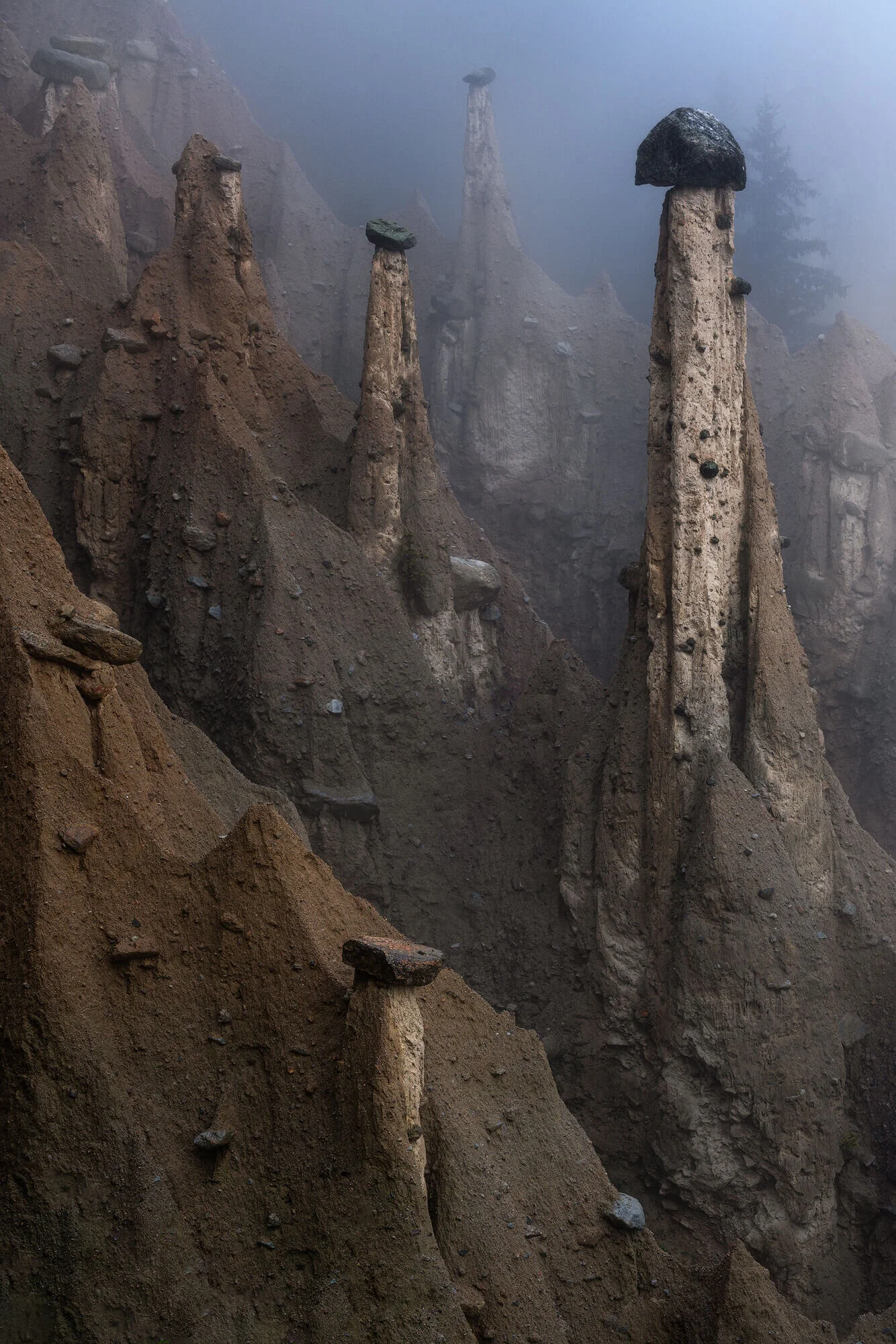
Eroded earth pyramid rock formations in moody rain, Dolomites, Italy
Don't hold your shoot hostage to how you imagined it would go. This applies to all photography, but in landscape work it's decisive. We all plan for a certain light, a certain sky — but don't overrate that plan.
I've stood beside friends at incredible viewpoints while they complained the light was wrong, the clouds weren't moving right, the peaks didn't catch the glow. When they'd send me a phone snap of the scene, I'd be stunned — it was beautiful, and they were too locked into their expectation to see it. Your job as a photographer is to stop complaining and make the best of what's actually in front of you. This image proves the point: it was made on a miserable, pouring day in the Dolomites. No mountains visible at all. Terrible for peak photography — but perfect, I realized, for the moody, mysterious earth pyramids I'd always wanted to shoot. The bad day was the shot.
12. Find inspiration away from social media

When I browse the work of artists I admire on social media, I get pulled into social-media behavior — notifications, messages, likes — and I can't actually connect with the art. The fix is simple: go to the artist's own website and view the work full-screen, phone off, no notifications. With nothing competing for your attention, the connection is deeper and the inspiration lands on a different level.
Better still are books and prints. They cost money, yes — so I set a little aside regularly to buy photo books from artists who inspire me. Both sides win: they make a living, and I get to sink into a sofa with a good drink and lose myself completely in their work. That kind of deep, undistracted inspiration will do more for your photography than a thousand scrolls ever could.
Start where you are
None of these twelve tips require a plane ticket or expensive gear. They require attention, repetition, and the willingness to go out and shoot — especially when it's inconvenient. Do that consistently, and you will get better. I've watched it happen for hundreds of photographers, and it happened for me.
Before I press the shutter — anywhere in the world — I run through four quick checks that keep my compositions strong under pressure. I've put all four into a free guide called The Field Method. You can grab it here.
Keep learning — more from Stories from the Wild
If these tips were useful, here's where to go next:
You Don't Need a Plane Ticket to Become a Better Landscape Photographer — why your own neighbourhood is the best training ground you have.
Best Winter Photography Locations on the Lofoten Islands — a practical, field-tested guide to shooting the archipelago that shaped my whole journey.
How to Photograph the Aurora Borealis — everything I keep in mind to capture the northern lights, even with today's capable cameras.
Which Camera Should You Choose for Landscape Photography? — the models I recommend, and why this is the decision that matters least.