The Truth About Telephoto Compression
A visitor recently wrote to tell me my site was flawed. Telephoto compression, he said, is a myth — an old wives' tale — and "it doesn't matter what lens you use one bit."
I went to write back, because the point deserved a proper answer. But the address turned out to be fake, and my reply had nowhere to land. So the question sat with me for weeks. This post is the reply I couldn't send — aimed at the argument, not the man, because it's a common argument and worth settling.
He was half right. And the half he got wrong is the half that decides whether you come home with a photograph.
Quick answer: A telephoto lens does not create compression. Perspective — how near and far stack against each other — is set by your distance from the subject, not by focal length. Focal length doesn't change perspective at all. But the effect photographers call lens compression is real, because a long lens is what lets you stand far enough back to make that stacking usable. The physics is about distance. The craft is about the lens.
The physics: he's right, and I'll concede it completely
Perspective is governed by one thing only: the distance between your camera and your subject. The size relationship between near and far, the way foreground and background stack against each other, all of it comes from where you stand. Focal length has nothing to do with it.
There's a clean test. Stand in one spot. Shoot at 24mm, then at 400mm, without moving your feet. Crop the wide frame to match the tele framing. The stacking of near against far will be identical, because you never changed your distance. As long as both frames hold enough resolution for what you need, they'll be indistinguishable in perspective. This is exactly why physicists say focal length doesn't change perspective, and they're right. I'll concede it once and for all.
A lens doesn't bend space. Nothing about the glass changes the geometry of what sits where.
But a photograph isn't only its perspective. It's a usable image, and that's where this stops being simple.
So why do the images look completely different?
Picture a portrait: a climber standing in front of Cerro Torre. I want her a certain size in the frame, and I want that impossible spire towering behind her.
With a telephoto, I walk far back, a couple of hundred meters, and frame her from there. Because I'm already a long way from her, the extra distance out to the mountain is only a small fraction of the total. Their apparent sizes stay close, so the mountain keeps most of its scale relative to her. It looms. It stacks right up behind her shoulder.
Now I switch to 24mm and want her the same size in the frame. To fill that much of a wide frame with a person, I have to walk right up to her. And the moment I do, the mountain collapses into the distance. It shrinks to a bump on the horizon, because the peak is now many times farther from me than she is.
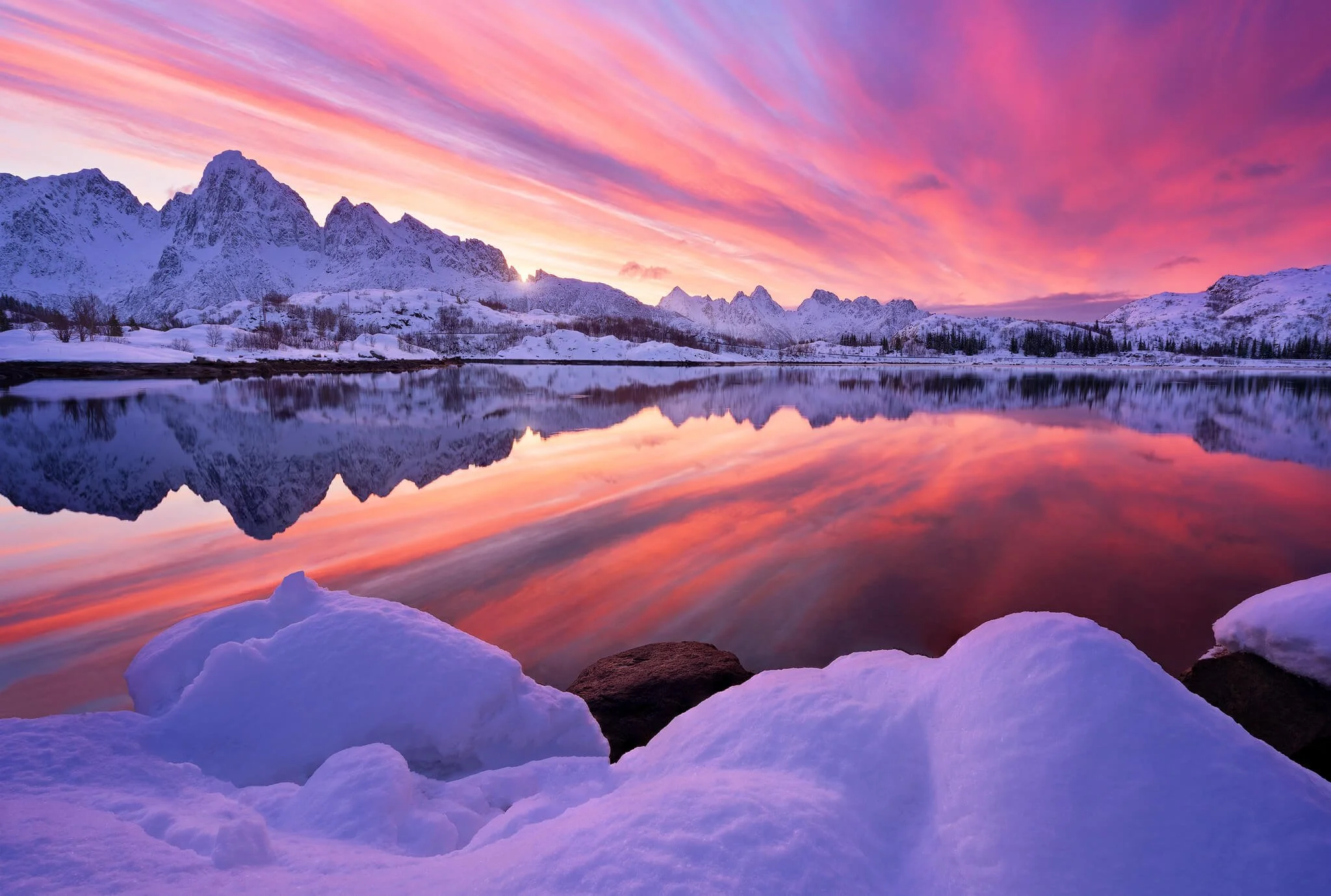
Lofoten — 14mm. The opposite move. Stand close with a wide lens and the foreground swells while the peaks shrink back. Nothing stacks here; everything separates. Same physics as the compression shots — just run in reverse.
Two completely different photographs. And yes, technically it was my distance that did the work, exactly as the physics says. But the telephoto is what let me stand back there and still fill the frame with her.
A telescope doesn't make the Moon larger. It lets you see it larger. A telephoto lens works the same way. It doesn't alter perspective; it lets you use a distant viewpoint while still filling the frame.
The lens doesn't create the compression. It's what makes the compression usable.
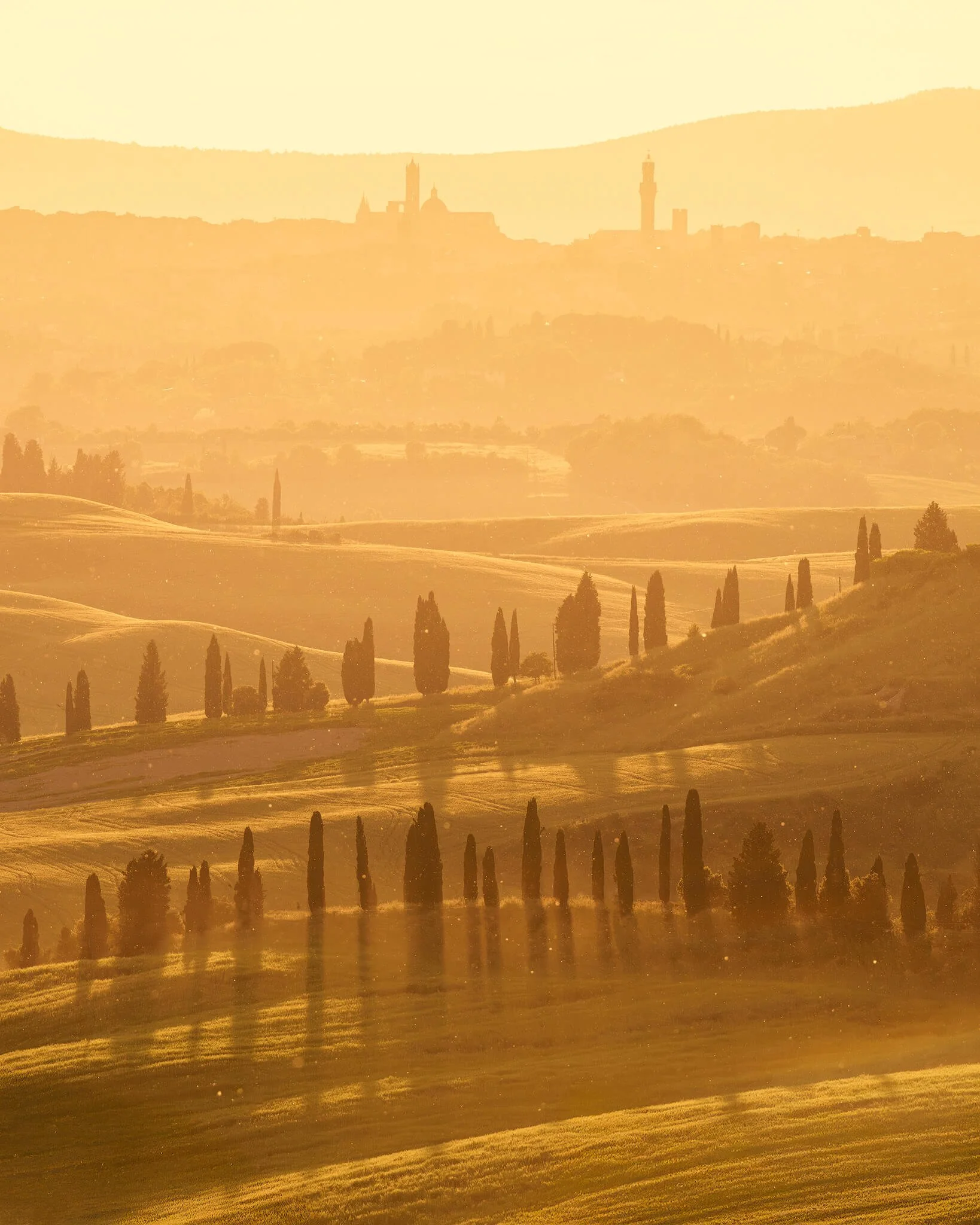
Tuscany at 500mm. To stack the cypresses, the far hills and Siena's skyline into a single wall of layers, I had to stand a very long way back. The distance did the compressing — but only the focal length made that distance workable.
Why "just crop the wide shot" fails in the real world
Here's where the argument overreaches. Because perspective is only distance, it's tempting to conclude the lens is irrelevant: shoot wide, crop in. In theory, fine. In practice it collapses, for reasons that have nothing to do with perspective and everything to do with the photograph.
Resolution. Cropping a wide frame down to a telephoto framing throws away most of your pixels. Crop a 100-megapixel file to a 400mm-equivalent framing and you may be left with six. A native long lens puts the entire sensor on the subject. That's the difference between a print and a thumbnail.
Rendering. A native long lens also draws the scene differently. How the out-of-focus areas dissolve, the quality of the background separation, the optical character the lens design itself imparts. None of that is a function of framing. A cropped wide frame keeps the perspective but can't reproduce those optical properties, because the formula that made them was never in the file.
Detail through atmosphere. Haze limits how much detail reaches the sensor in the first place, whatever lens you use. What the long lens does is sample that distant detail with far more pixels. Crop a wide frame to the same framing and you throw most of those samples away. What survived the haze is still out there, you simply kept too little of it.
The perspective may match — the photograph doesn't.
One boundary worth naming. For moderate reach, cropping a high-resolution file does work. A 45-megapixel body cropped from 24mm to something around 50mm still holds up beautifully. It's only when you reach for real telephoto compression, the 300s and the 500s, that the crop becomes the limiting factor. The pixels simply aren't there.
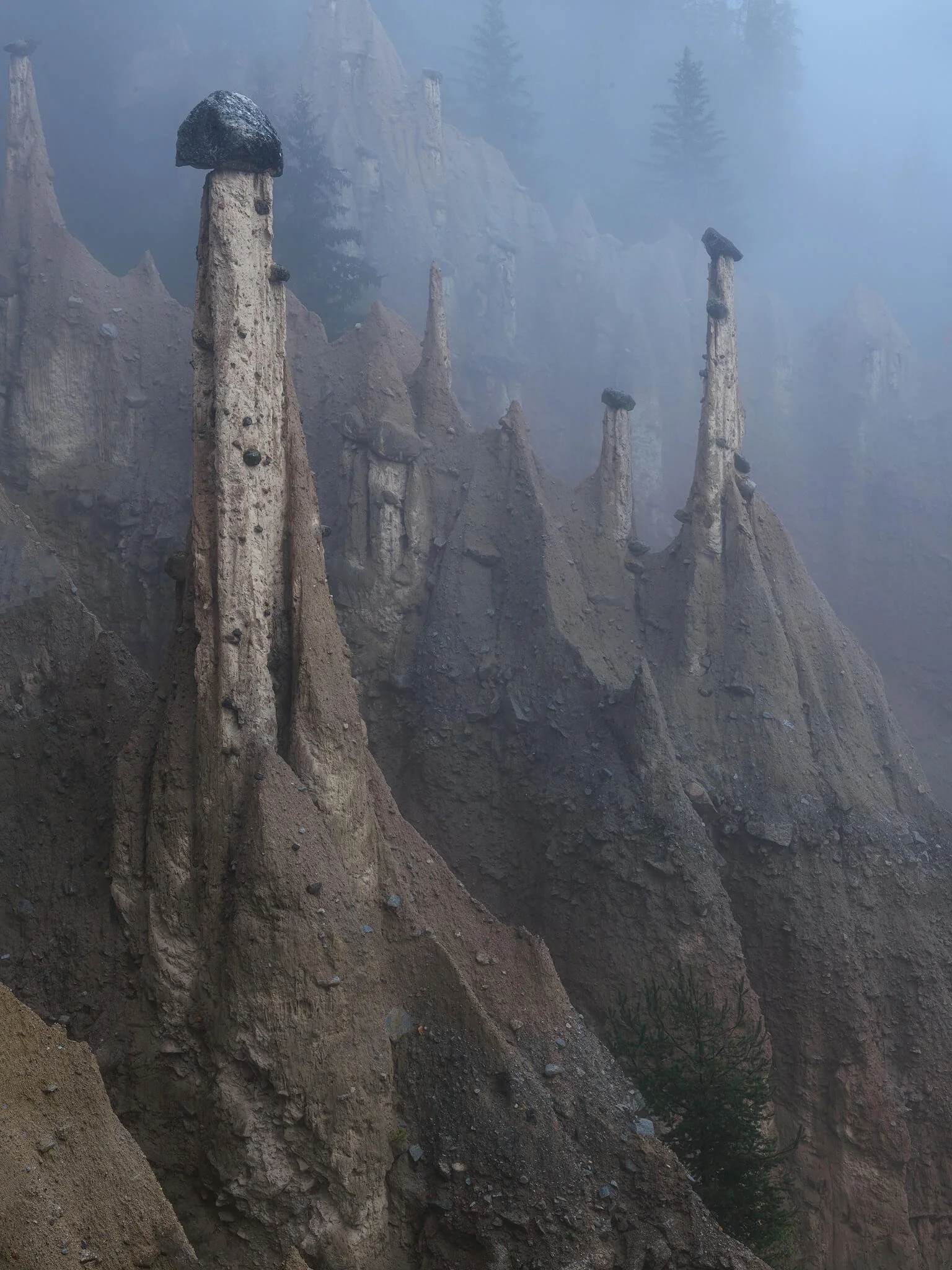
The earth pyramids at 35mm — moderate reach, the range where a crop from a wider frame would still have survived. The collapse comes later, further down the focal length.
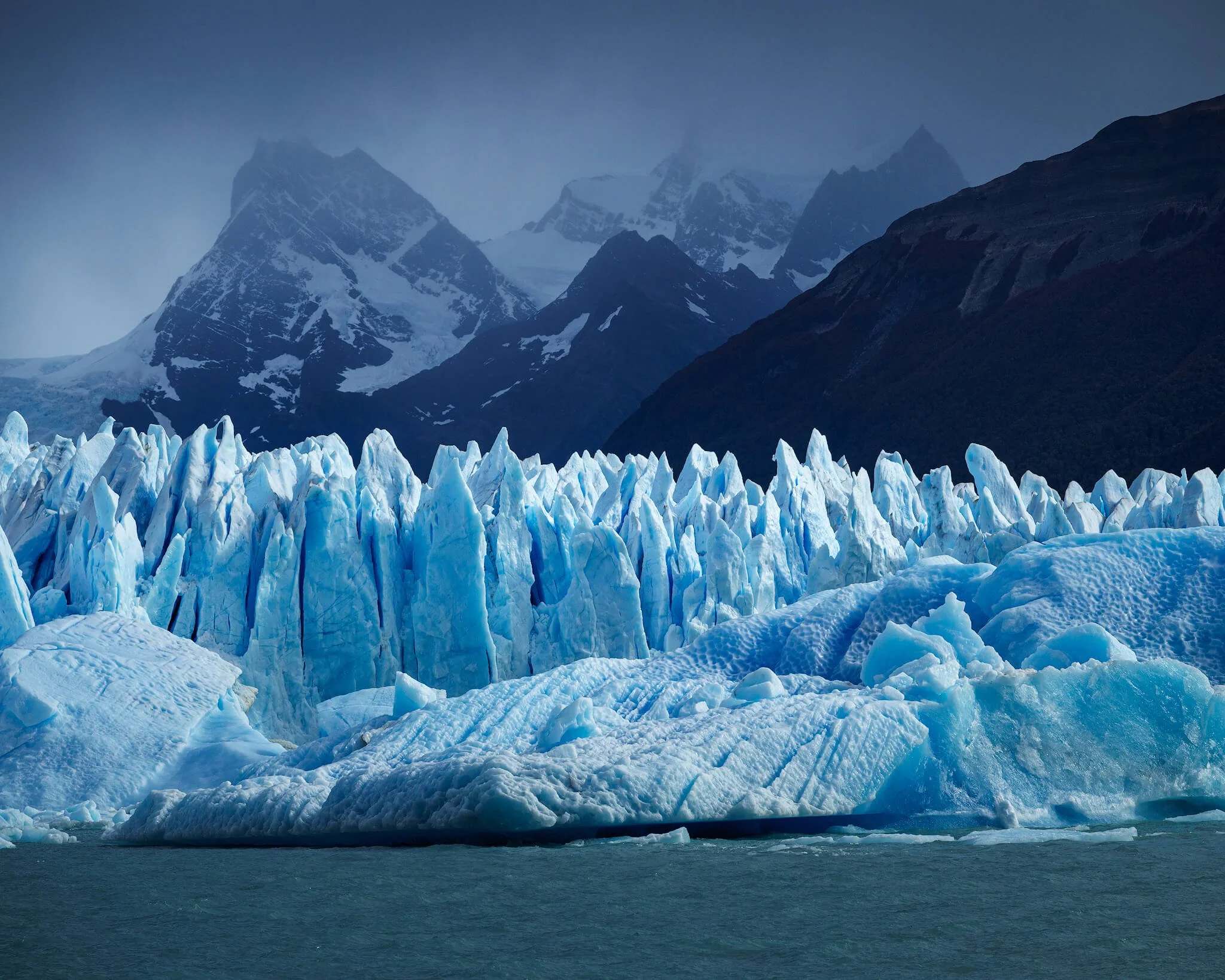
Perito Moreno at 120mm, shot from the water. The peaks press up behind the ice not because the lens moved them, but because I was far enough back that near and far sat close in scale. The reach let me shoot from there at all.
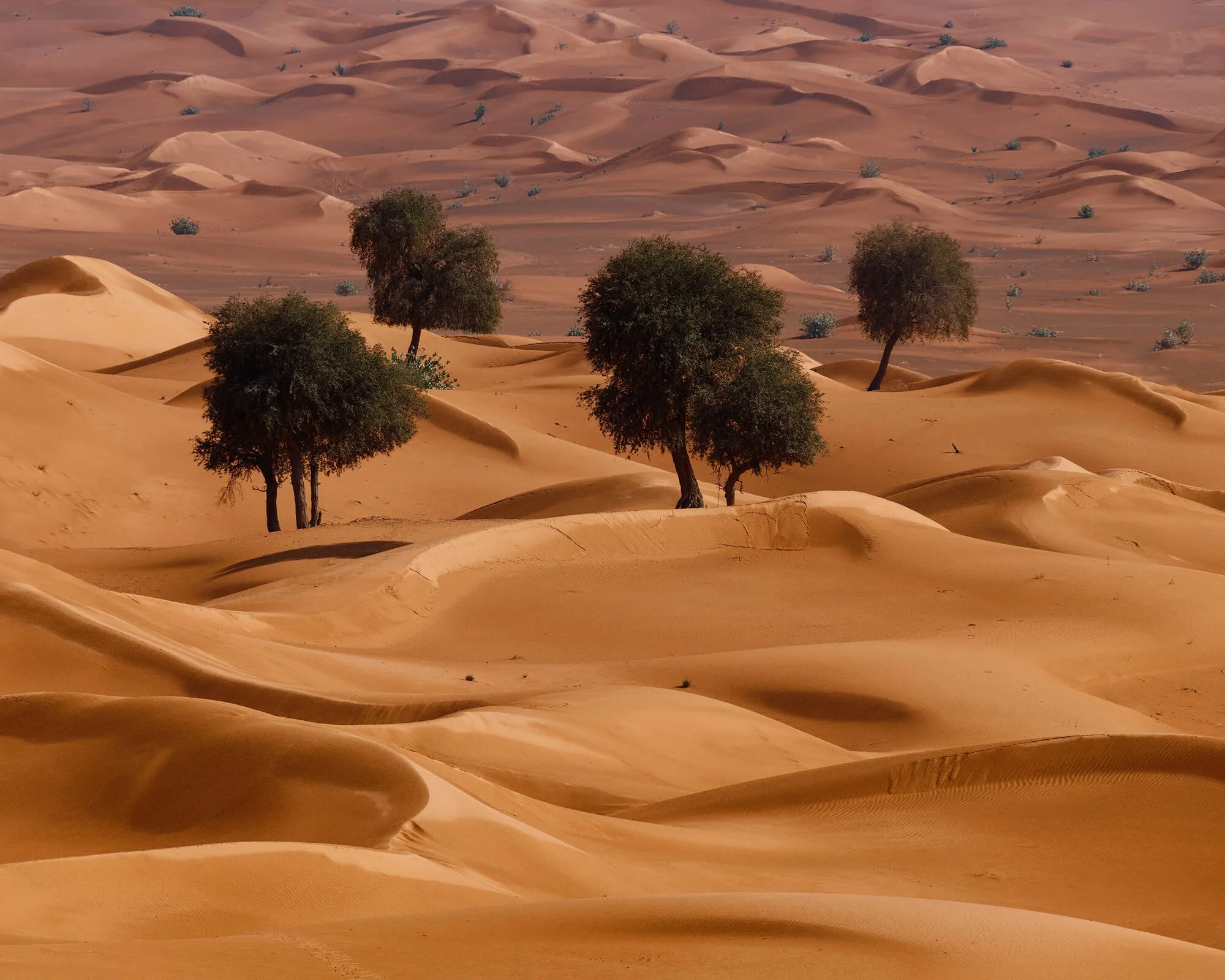
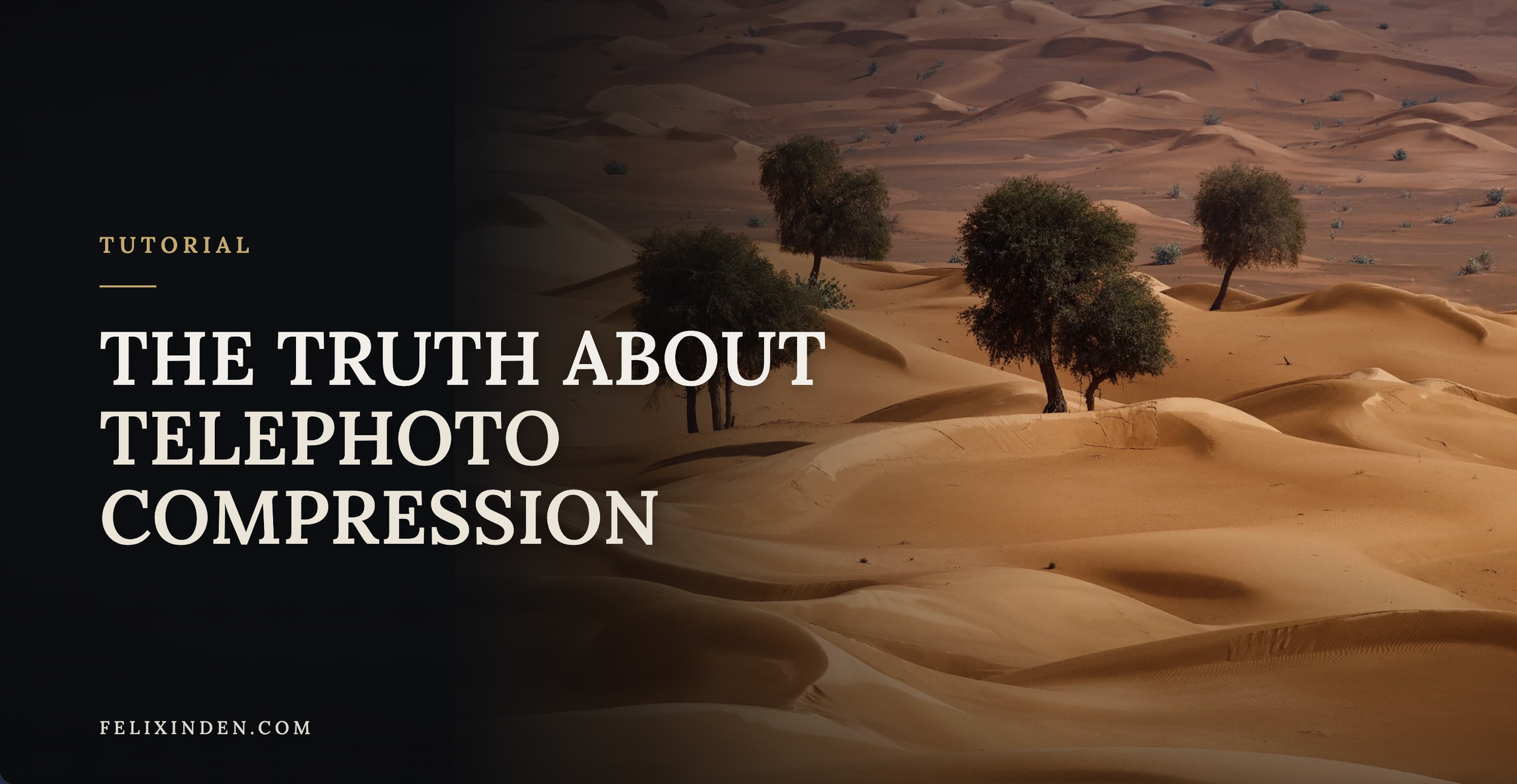
Green ghaf trees scattered across rolling orange sand dunes, with row after row of dunes stacking into the distance behind them. Shot at 500mm- not only because i wanted the visual effect. I simply had to shoot from where i was standing or go home without a shot… and i was standing hundreds of meters away from the trees.
So why does the entire field say "compression"?
If the effect is really about distance, why does every photographer, magazine and manufacturer call it lens compression?
Because in practice the lens and the look are inseparable. Only a long lens makes shooting-from-distance usable, so the two always arrive together. When a photographer says "put on the 400 and compress the scene," they aren't making a claim about optics. They're naming the decision they made and the look that reliably follows from it.
You'll see the same look filed under a dozen names: lens compression, perspective compression, compressed perspective, telephoto perspective. They all point at the same thing, the stacked and flattened rendering a distant viewpoint produces.
That's what craft language does. It names the lever you pull, not the underlying geometry. A sailor talks about the wind pulling the boat forward; a physicist would describe pressure differentials across a curved surface. Both are correct at their own level, but the sailor's version is the one that gets you across the bay.
"Compression" describes the image, not the glass. That's why the myth-busting misses: it disproves something no working photographer ever meant. And the shorthand teaches faster. Tell a beginner to use a long lens to compress the scene and they'll be making stacked ridgelines by this afternoon.
What to actually do with this
Both halves are worth carrying. The mechanism sharpens your understanding: when compression isn't working, the fix is almost never the lens, it's your feet. And the shorthand runs your practice, because in the field you think in focal lengths, not meters.
So, practically:
To compress, to stack layers, to pull a distant town up behind a near ridgeline: get distance first, then reach for the focal length that fills the frame from where you're standing.
To separate, to make a foreground dominate and push everything else back: get close, and go wide.
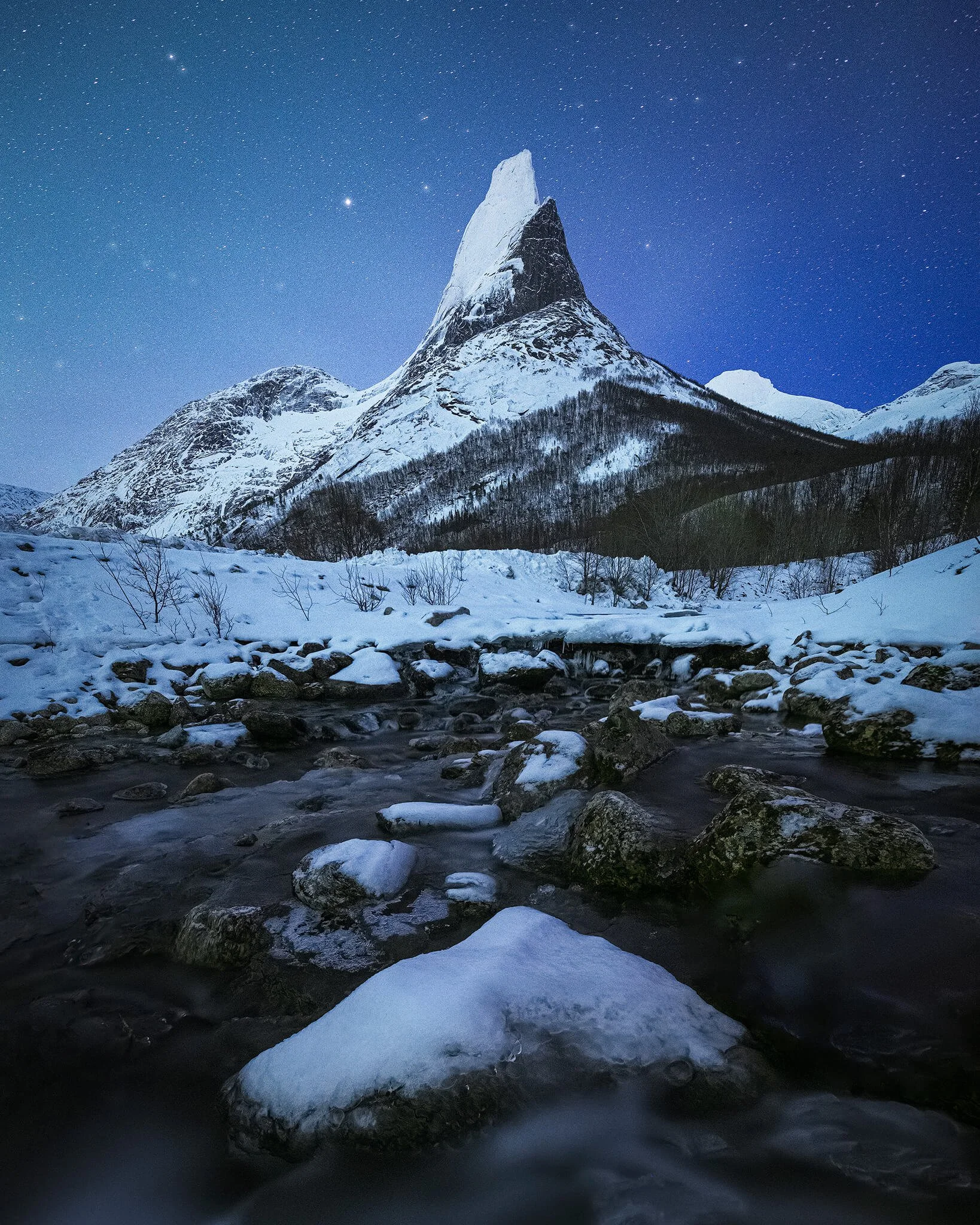
Stetinden at 14mm. Standing almost on top of the frozen rock, the near stones swell and the peak recedes into its own distance — the opposite move, and the opposite lens.
My visitor was right about the geometry and wrong about the conclusion. The lens does matter, just not for the reason the myth claims.
Compression is one way to build layers in a frame. It isn't the only one — and layering is just one of four things I check before the shutter ever moves.
The Field Method is that checklist, free: The Anchor, Edge Control, The Layers, The Light Rule. One page. It's the difference between a frame that holds together and one that falls apart.
Keep going:
The Best Lenses for Landscape Photography — If this piece convinced you the lens is a tool and not a magic trick, here's how I actually choose which one goes on the camera.
How to Improve Your Landscape Photography Without Traveling — Same lesson as compression, wider application: the biggest gains almost never come from new gear or a plane ticket. They come from how you work what's in front of you.
12 Ways to Improve Your Landscape Photography — The groundwork. Twelve things that move your photographs further than any lens on the shelf.